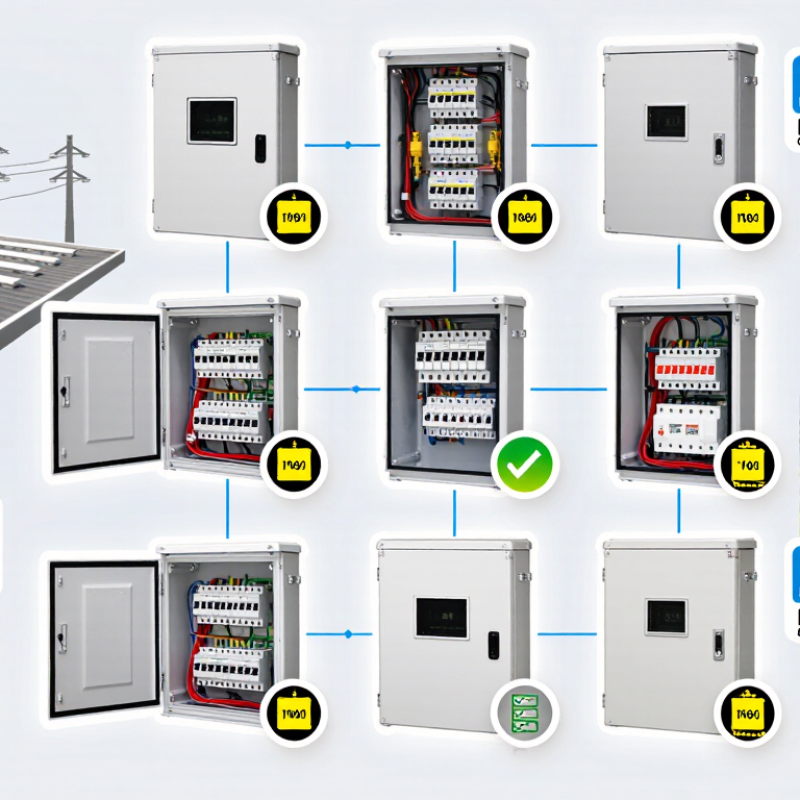
| 1 | Product Configuration | Confirm the number of input strings, output circuits, fuse positions, monitoring options, and enclosure layout. | The configuration should match the PV array design, inverter input limits, and project voltage class without unused or overloaded circuits. | Approved datasheet, single-line diagram, wiring diagram, and customized bill of materials. |
| 2 | Rated Voltage and Current | Check maximum continuous voltage, input current, output current, short-circuit withstand capability, and derating conditions. | The ratings must be equal to or higher than the calculated maximum system voltage and operating current, including site temperature effects. | Nameplate photo, type-test report, electrical calculation, and temperature-derating curve. |
| 3 | Fuse and Circuit Protection | Verify that fuse holders and fuses are suitable for photovoltaic direct-current service and that the fuse rating matches the module and string design. | Use PV-rated DC fuses with voltage and interrupt ratings appropriate for the project; do not substitute ordinary AC fuses. | Fuse and holder datasheets, coordination study, traceability records, and sample inspection report. |
| 4 | Surge Protection | Check the type of DC surge protective device, continuous operating voltage, discharge current, failure indication, and replaceability. | The selected SPD should be coordinated with the PV system voltage and the site lightning-protection design. IEC 61643-31 is the relevant PV DC SPD reference. | SPD test certificate, product marking, wiring diagram, and replacement procedure. |
| 5 | Enclosure and Environmental Protection | Evaluate ingress protection, UV resistance, corrosion resistance, drainage, cable glands, ventilation, and operating temperature. | The IP rating should be selected for the installation environment and verified according to IEC 60529. Outdoor projects commonly require a sealed, UV-resistant enclosure. | IP test report, material specification, UV-aging data, corrosion test results, and enclosure drawings. |
| 6 | Electrical Safety and Compliance | Review insulation, creepage and clearance distances, grounding provisions, labeling, touch protection, and DC isolation procedures. | Design documentation should reference applicable project requirements, IEC 61439-2 where relevant, and local market regulations. | Routine-test records, dielectric-strength test results, insulation-resistance results, and compliance declaration. |
| 7 | Monitoring and Communication | Determine whether the unit supports string-current monitoring, voltage measurement, temperature sensing, alarm output, and the required communication protocol. | Monitoring functions should be compatible with the plant SCADA or data-acquisition system and should not compromise DC insulation or protection. | Communication protocol, register map, wiring diagram, software screenshots, and interoperability test record. |
| 8 | Manufacturing Quality Control | Assess incoming inspection, component traceability, torque control, wiring inspection, labeling control, and final functional testing. | Every finished unit should have a traceable serial number and documented inspection results before shipment. | Quality manual, inspection and test plan, sample quality records, calibration certificates, and factory-audit report. |
| 9 | Customization and Project Support | Evaluate engineering response time, drawing revision control, local electrical requirements, language support, and installation documentation. | A capable supplier should provide project-specific drawings, clear approval workflows, and installation instructions before mass production. | Technical questionnaire, approval drawing, response-time record, installation manual, and change-control procedure. |
| 10 | Delivery, Warranty, and After-Sales Service | Compare production lead time, packaging, spare-parts availability, warranty terms, failure-response process, and long-term service capability. | The commercial offer should define delivery terms, inspection rights, warranty exclusions, replacement timelines, and responsibilities for field failures. | Signed warranty, quality agreement, packing specification, spare-parts list, service-level agreement, and reference-project documentation. |
 English
  Česká republika
 Deutsch
 Dutch
Dutch Polska